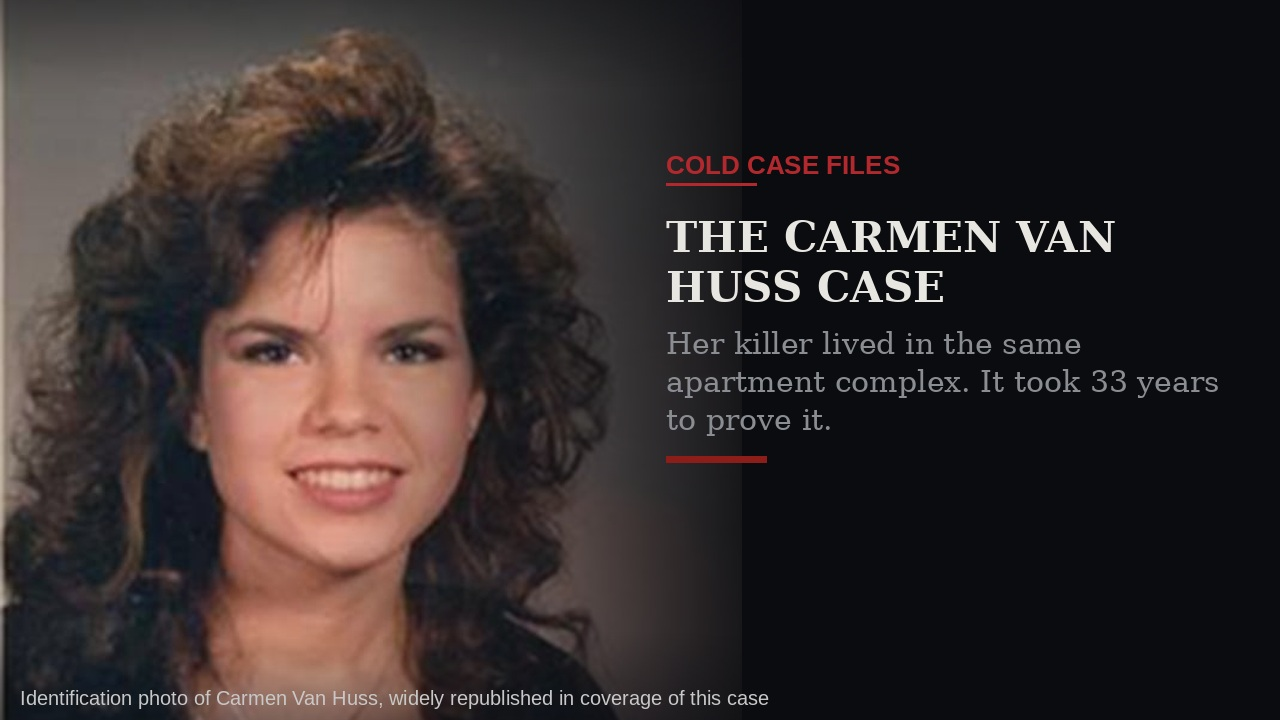
On the afternoon of March 24, 1993, a father let himself into his daughter’s apartment on the north side of Indianapolis because she had stopped answering her phone. Carmen Van Huss was 19 years old, an art student at IUPUI, remembered by her family as an animal lover who took in stray cats. Her father found her dead. It would be 33 years before anyone was held responsible.
What made the difference in the end was not detective work in 1993 – it was a decision by evidence technicians to collect, package and preserve biological evidence that nobody at the time could read. Over the following three decades, DNA testing eliminated no fewer than 40 possible suspects. The case was reopened in 2000. A witness was ruled out in 2009. In 2013, analysts developed a full genetic profile of an unknown male – and CODIS, the national DNA database, returned nothing, because the man had never been entered into it.
In 2018 the sample went to Parabon NanoLabs for forensic genetic genealogy, a technique that does not ask whether a suspect is on file but whether anyone related to him is. The testing was funded not by a police budget but by Season of Justice, a nonprofit – Carmen’s family has said publicly that they spent more than a decade being told the money wasn’t there, and that they weren’t allowed to pay for it themselves. In 2023 the genealogy pointed investigators to a man who had lived in Carmen’s own apartment complex in 1993. Dana Jermaine Shepherd was arrested in Columbia, Missouri in 2024, extradited that November, and sentenced on February 13, 2026.
This video covers the March 1993 scene and what was preserved from it; how DNA testing and CODIS actually worked at the time, and why a database search can never solve a case involving someone who isn’t in the database; what makes biological evidence survive 30 years in storage and what destroys it; the 2000 reopening and the 2009 elimination; the 2013 profile; how forensic genetic genealogy works step by step and how new it really is; the funding problem that nearly ended the case; the 2023 identification; the arrest, the extradition fight and the plea; what 45 years means under Indiana’s 1993 sentencing rules; the family’s own statement on the plea; and Indiana House Bill 1248, the legislation Carmen’s relatives are backing to let private and nonprofit money pay for cold-case DNA testing in a state with more than 7,200 unsolved homicides.
Related reading:
No book has been written about this case specifically. But this is a genuine forensic genetic genealogy case, and the definitive account of how that technique works and where it came from is:
The Forever Witness: How DNA and Genealogy Solved a Cold Case Double Murder, by Edward Humes (4.6 stars, 480+ ratings)
https://www.amazon.com/dp/1524746274?tag=truecrimecases-20
As an Amazon Associate I earn from qualifying purchases.
Subscribe for a new documented case every day.
#truecrime #truecrimecommunity #coldcasefiles #carmenvanhuss #geneticgenealogy
Leave a Reply