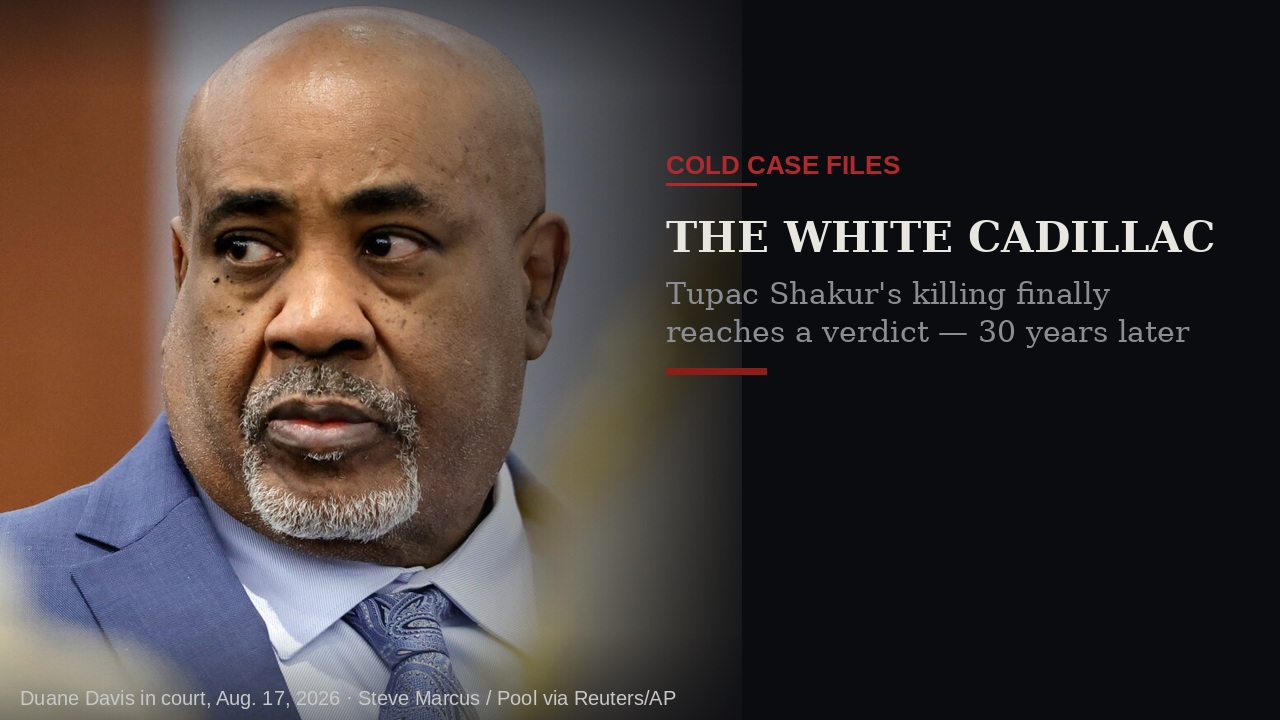
He told the story of Tupac's murder for years. Then a jury finally listened.
On the night of September seventh, nineteen ninety-six, Tupac Shakur was twenty-five years old and one of the most famous musicians on the planet. By the end of that night he would be in a Las Vegas trauma unit with four gunshot wounds. Six days later he was dead. For twenty-seven years, nobody was charged. And when someone finally was, the evidence that put him in front of a jury came almost entirely from his own mouth. This is the story of the white Cadillac.
Tupac Amaru Shakur was born in New York in nineteen seventy-one and spent part of his teens in Baltimore, where he studied at the Baltimore School for the Arts. By the mid-nineties he was a multi-platinum artist, a film actor, and one of the most polarizing figures in American music. In late nineteen ninety-five he signed with Death Row Records, the Los Angeles label run by Marion "Suge" Knight. Death Row had deep ties to a Compton street gang called the Mob Piru, aligned with the Bloods. Their rivals, the South Side Compton Crips, had become associated with the East Coast label Bad Boy Records and its star, the Notorious B.I.G. What began as a business rivalry between two labels had hardened into something far more dangerous.
On September seventh, Shakur and Knight were in Las Vegas for the heavyweight fight between Mike Tyson and Bruce Seldon at the MGM Grand Garden Arena. Tyson won in under two minutes. As Shakur's group moved through the hotel afterward, one of them spotted a man named Orlando Anderson, a South Side Crip who had reportedly been involved in a confrontation with a Death Row associate weeks earlier. Hotel surveillance cameras recorded what happened next. Shakur and his entourage attacked Anderson in the lobby area, punching and kicking him until hotel security broke it up. Anderson declined to press charges. The whole thing lasted less than a minute. It would prove to be the trigger for everything that followed.
Orlando Anderson had an uncle. His name was Duane Davis, known on the streets of Compton as Keffe D. Davis was, by his own account, a senior figure in the South Side Compton Crips, a self-described shot caller who had run a large drug operation. Prosecutors would later say that when word of the beating reached Davis that night, he spent the next two hours planning how to get even.
Shortly after eleven that night, Knight was driving a black BMW sedan east on Flamingo Road, a block off the Strip, with Shakur in the passenger seat and a convoy of Death Row vehicles behind them. Minutes earlier, two Las Vegas bike officers had stopped the car for missing a license plate and let it go with a warning. At the intersection of Flamingo and Koval Lane, a white Cadillac pulled up alongside the passenger side. Someone in the back seat opened fire. Shakur was hit four times. Knight was grazed by a bullet fragment. The Cadillac drove off and was never recovered.
One of the officers who had stopped the BMW moments earlier, Garry Dale, reached the scene as paramedics pulled Shakur from the car. He climbed into the ambulance and asked the rapper who had shot him. Dale would testify three decades later that Shakur's answer was something like, "No, we'll take care of it." Tupac Shakur died at University Medical Center on September thirteenth, nineteen ninety-six.
The investigation stalled almost immediately. Detective Brent Becker of Las Vegas homicide later described witnesses who simply would not talk. Knight, the surviving victim, arrived for his police interview with lawyers and said he knew nothing. Becker's assessment, delivered from the witness stand in twenty twenty-six, was blunt: "I thought he lied to us." Investigators believed four men had been in the Cadillac, Davis, Anderson, Deandre Smith and Terrence Brown, but they had no living witness willing to identify them. Anderson was shot dead in Compton in nineteen ninety-eight. Smith and Brown also died in the years that followed. Meanwhile, six months after Shakur's death, the Notorious B.I.G. was killed in a drive-by in Los Angeles. That case remains unsolved to this day.
For more than a decade, the Las Vegas case sat cold. What eventually revived it was not new forensic evidence. It was Duane Davis talking.
In two thousand eight, Davis was facing federal drug charges in Los Angeles. He agreed to sit down with a federal task force investigating the Notorious B.I.G. killing, under what is known as a proffer agreement. The rules were explained to him at the start of the recording: nothing he said in that room could be used against him. Instead of talking about Biggie, Davis walked the investigators through the night Tupac was shot. He described getting a gun from an associate, riding in the front passenger seat of the white Cadillac, spotting the BMW, and passing the weapon into the back seat. When an investigator asked whether he would have fired himself, Davis answered, "If he would have been on my side, I would have blasted." The following year he repeated his account to Las Vegas police.
That should have been the end of it. A proffer is confidential, and its whole purpose is to let a witness speak without fear of prosecution. But in twenty eighteen, Davis began giving television interviews about the shooting. And in twenty nineteen he co-authored a memoir called "Compton Street Legend," in which he told essentially the same story, in his own name, for sale to the public. A court would later rule that by doing so he had waived the protection the proffer gave him. The one man who had been legally shielded from his own words had, in the prosecution's phrase, a hard time being silent.
Las Vegas police reopened the case. On July seventeenth, twenty twenty-three, a SWAT team served a search warrant at Davis's home in Henderson, Nevada. Body camera footage of that raid was later released by the department. Detectives seized computers, a hard drive, tubs of photographs, forty-caliber ammunition, a magazine featuring Shakur, and a copy of "Compton Street Legend." On September twenty-eighth, a Clark County grand jury indicted Davis on one count of murder with use of a deadly weapon, with a gang enhancement. At seven the next morning, officers arrested him as he walked near the end of his street. He was sixty years old, and the last living person believed to have been in that car.
There is no statute of limitations on murder in Nevada. And under Nevada law, a person who aids or abets a killing can be charged with the murder itself, not only the person who pulls the trigger. That was the legal theory prosecutors built their case on.
After nearly three years of pre-trial hearings, jury selection began on August tenth, twenty twenty-six, at the Regional Justice Center in downtown Las Vegas. Opening statements came a week later. Chief Deputy District Attorney Binu Palal was direct with the jury: "Let's be clear, Duane Davis did not pull the trigger. But he did plan the shooting in retaliation of the beating of his nephew. Remarkably, you will learn that from Duane Davis himself." Defense attorney Michael Sanft called the prosecution's narrative fiction. Davis, he said, was a man who told a dramatic story for money and attention, and police had never charged him before precisely because they knew he was, in Sanft's words, "full of crap."
Over nine days, jurors heard from twenty-four prosecution witnesses and three for the defense. They watched the MGM Grand surveillance video of the beating. They heard retired officers and detectives, some testifying by video feed, describe the scene and the silence that followed. They heard a woman named Ingrid Stokes, who had been in a car one lane over, describe the gunshots and why she had stayed quiet for decades. Her words to the jury were three: "Snitches get stitches."
And then they heard Duane Davis. Prosecutors played the two thousand eight interview in the courtroom, around two hours of it. Shakur's family sat in the gallery and listened to the defendant describe, in his own voice, handing the gun to the back seat. Prosecutors then held up his memoir, and played an interview in which Davis urged people to buy the book to get "the real truth." The book carries a disclaimer that some details were changed. The prosecution argued its central account never did.
The defense pressed hard on what the state did not have. There was no physical evidence tying Davis to the Cadillac. No phone records. No surviving co-defendant. No fingerprint, no weapon. Sanft told the jury, "They have nothing in this case that says that man was here in Las Vegas on September seventh, nineteen ninety-six." He pointed to missing documents from the original investigation and to friction between police departments. Prosecutor Marc DiGiacomo answered with a scrapbook detectives had found in Davis's home, filled with clippings about Shakur. "This guy's scrapbooking his murder," he told jurors, "for God's sake."
Before the case went to the jury, the state dropped the gang enhancement, citing witness logistics. On Monday, August thirty-first, twenty twenty-six, the jury retired to deliberate. They were back in under three hours. Duane Davis, sixty-three years old, was found guilty of first-degree murder with use of a deadly weapon.
When the verdict was read, Shakur's sister, Sekyiwa Shakur, wept and embraced the prosecutors. Davis's son covered his face with his hand. The family said they would wait until sentencing to speak publicly. That hearing is scheduled for October, and Davis faces up to life in prison. Whatever the number turns out to be, it will be handed down almost exactly thirty years after a white Cadillac pulled up at a red light on Flamingo Road.
Thirty years, one conviction, and a man convicted largely by his own retelling of the story. Do you think the verdict was the right one, and what sentence do you think fits? Let us know in the comments.
Related reading
"Murder Rap: The Untold Story of the Biggie Smalls & Tupac Shakur Murder Investigations" by Greg Kading — the retired LAPD detective who led the task force whose 2008 interview with Davis became the centerpiece of this trial (4.6★, 800+ ratings):
https://www.amazon.com/dp/0983955484?tag=truecrimecases-20
As an Amazon Associate I earn from qualifying purchases.
Sources and credits
FACTUAL SOURCES
- Associated Press via NPR, "Jury convicts a man of first-degree murder for
  the 1996 killing of rap icon Tupac Shakur," Sept. 1, 2026 (verdict; jury
  of 16 incl. 4 alternates; 24 prosecution / 3 defense witnesses over nine
  days; gang enhancement dismissed; closing-argument quotes from Binu Palal,
  Michael Sanft and Marc DiGiacomo; Sekyiwa Shakur; sentencing in October).
- Associated Press via NPR, "A dispute about fact vs. fiction at the trial
  over Tupac Shakur's 1996 killing," Aug. 18, 2026 (opening statements;
  Garry Dale and Brent Becker testimony; Ingrid Stokes; 1998/1999 FBI
  contacts and 2009 LVMPD interview; Deandre Smith and Terry "Bubble Up"
  Brown named as the other Cadillac occupants; Fred Miller on the
  Notorious B.I.G. case).
- NPR Morning Edition, Steve Futterman, "Man on trial for death of rapper
  Tupac Shakur takes the stand," Aug. 21, 2026 (the 2008 recorded
  interview played in court, its confidentiality language, and the
  "I would have blasted" exchange; court's ruling that the memoir and
  interviews waived the protection).
- CNN, trial coverage Aug. 17 and Aug. 26, 2026 (jury selection began
  Aug. 10; prosecution rested after a week and a half).
- CBS News, Cara Tabachnick, "Who is Duane 'Keffe D' Davis?", Sept. 30,
  2023 (LVMPD news conference; Sheriff Kevin McMahill and DA Steve Wolfson;
  July 17, 2023 Henderson search-warrant inventory; Davis's own memoir
  account of his background).
- KLAS 8 News Now, "Las Vegas police report reveals more about arrest in
  Tupac Shakur murder case," Oct. 2023 (grand jury vote Sept. 28, 2023;
  arrest ~7 a.m. Sept. 29 near his Henderson home; Flamingo/Koval; no
  statute of limitations; aiding-and-abetting theory).
- Background on Shakur's life, Death Row Records and the 1996 Las Vegas
  fight is drawn from those same sources and long-established public
  reporting; the narration attributes disputed points (who fired, why
  Anderson was targeted) to prosecutors or witnesses rather than stating
  them as fact. Who pulled the trigger was not established at trial and is
  not asserted in this video.

VISUALS
- Tupac Shakur, c. 1996 California driver's license photograph: Wikimedia
  Commons, tagged public domain (opening and closing slides, Facebook
  teaser card). Source is a small 248x293 file, upscaled before fitting.
- Tupac Shakur, 1988, photographed for The Evening Sun (Baltimore) at the
  Baltimore School for the Arts: Wikimedia Commons, tagged public domain.
- Duane Davis in court, Aug. 17, 2026, and listening to video testimony
  the same day: Steve Marcus / Pool via Reuters/AP — courtroom pool
  photographs of the public proceeding, hosted by NPR (used for the
  opening Davis slide, the "interviews" slide, the teaser card and the
  thumbnail).
- "The White Cadillac" prosecution exhibit as displayed on the courtroom
  monitor, Aug. 17, 2026: Steve Marcus / Pool via Reuters/AP.
- Davis and attorney Michael Sanft after the verdict, Aug. 31, 2026:
  Bizuayehu Tesfaye / Las Vegas Review-Journal pool via AP.
- MGM Grand by night: Tristan Surtel, CC BY-SA 4.0, Wikimedia Commons —
  recent photo, not 1996.
- Flamingo Road near Koval Lane (Platinum Hotel view): CC BY-SA 3.0,
  Wikimedia Commons — recent photo, not the 1996 scene.
- Regional Justice Center, Las Vegas: Coolcaesar, CC BY-SA 3.0, Wikimedia
  Commons.
- Compton city-limit sign: CC BY-SA 2.0, Wikimedia Commons.
- Tupac Shakur memorial statue: CC BY-SA 4.0, Wikimedia Commons.
- Cassette recorder, archived case files, gavel (Joe Gratz, CC0), scales
  (James Cridland, CC BY 2.0), evidence recovery team (IAEA Imagebank,
  CC BY 2.0), police lights, handcuffs/arrest, DNA lab: public domain /
  CC / licensed stock reused from earlier videos in this series — all
  illustrative, none depicting this case.
No news-broadcast footage was used. No LVMPD booking photograph of Davis
was fetchable from a clean public-record source (it circulated only as a
photo of a TV monitor at the news conference), so the courtroom pool
photographs stand in for it. The MGM Grand surveillance video and the
LVMPD body-camera footage of the 2023 raid were not used.