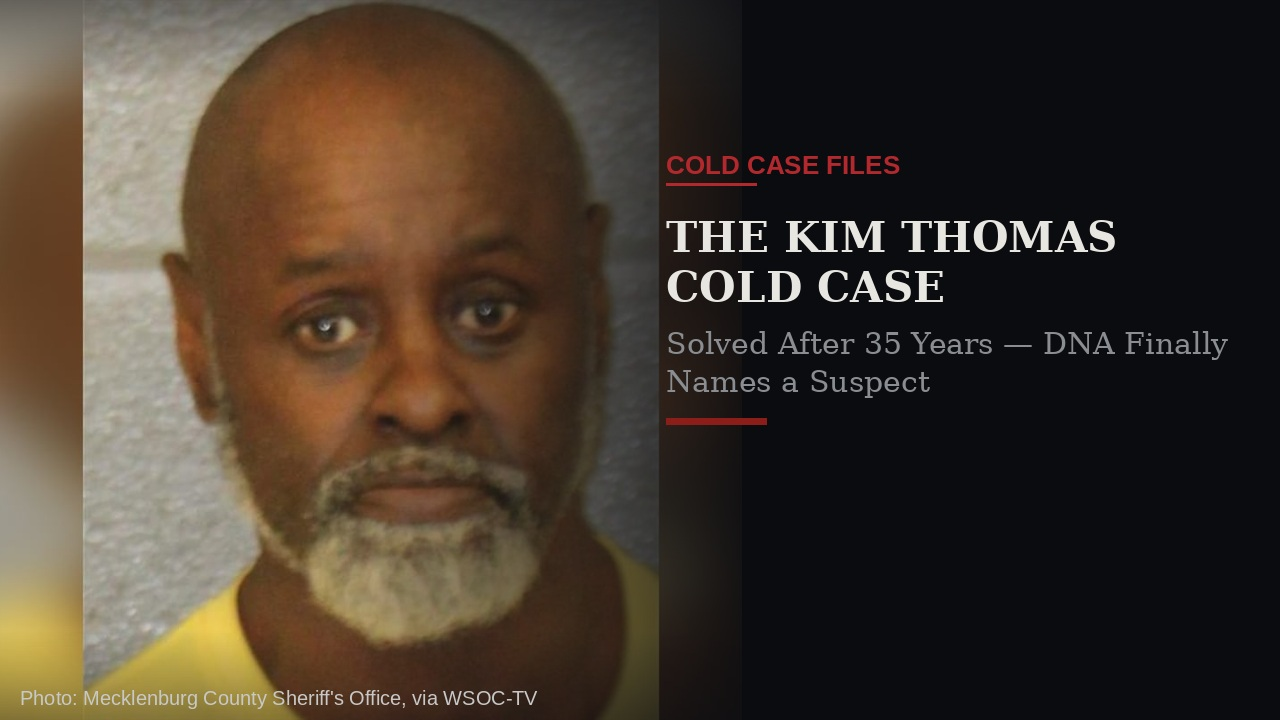
She was murdered in her own home in 1990. It took 35 years, a wrongly-suspected husband, and a DNA breakthrough to finally name a suspect.
On the night of July 27, 1990, Dr. Ed Friedland came home to the house he shared with his wife in Charlotte’s Cotswold neighborhood and found her dead on the floor. Kim Thomas was 31 years old. She had been stabbed, her throat slashed, and police say she had been handcuffed. Their infant child had been alone in the crib for hours — investigators later estimated as long as thirteen — crying, undiscovered, feet from the scene.
Thomas was known around Charlotte as an activist, involved with the National Organization for Women. A memorial plaque placed in her memory reads simply: “An Activist for Good Causes.” Her murder made front-page news.
Decades under suspicion
In the earliest days of the investigation, suspicion fell on the person closest to her. Four years later, prosecutors charged Dr. Friedland with his wife’s murder. The case was thin, and the charges were dropped without prejudice — meaning they could theoretically be refiled. For decades, they never were.
Friedland spent those decades under a cloud he says he never deserved. In a 2015 interview, twenty-five years after his wife’s death, he was blunt: “I can tell you one thing: I’m innocent. I was innocent. I am innocent. I will always be innocent, and I should never have been charged.”
While that reputation followed Friedland, another man moved quietly in and out of the case: Marion Gales, a handyman who had worked inside the home in the weeks before Thomas died. Court records now show that hours before her body was found, a neighbor called 911 to report a man in a red shirt and tan pants knocking on his door claiming to be a police officer. Officers arrived; the man was gone. Years later, that neighbor identified him as Gales. A separate witness told investigators they had seen Gales that same day with blood on his shirt.
The science that didn’t exist yet
For years the DNA evidence sat in storage. Investigators had mixtures of multiple people’s DNA on key items — a rug beside Thomas’s body, hairs recovered from her — but the forensic science of the era could not cleanly separate whose DNA was whose. Cold cases across the country hit the same wall: a suspect’s DNA might genuinely be present, but proving it wasn’t just noise in a mixed sample required tools nobody had invented yet.
What finally changed the case was not a new witness or a confession. It was better science. Newer testing using a method called probabilistic genotyping let the CMPD Crime Laboratory mathematically model mixed samples and calculate far more precisely which portions belonged to which contributor. Working with the private lab DNA Labs International, and with funding from the federal Sexual Assault Kit Initiative, CMPD’s Cold Case Unit re-analyzed decades-old evidence at a precision that did not exist in 1990 — or even a few years ago.
On February 17, 2026, the unit received a new lab report. It found that Marion Gales’s genetic profile matched pubic hairs recovered from Kim Thomas’s body, and DNA recovered from the rug beside her. Two days later, CMPD’s Violent Criminal Apprehension Team arrested Gales at a home in Charlotte.
Charged — and awaiting trial
According to investigators, Gales admitted at the Law Enforcement Center that he had been inside the home the day Thomas died and had sexual contact with her, but denied killing her. He was charged with first-degree murder. At his first court appearance his public defender argued for bond, citing age and health; a judge refused, citing the violent nature of the crime.
Marion Gales has been charged, not convicted. He is presumed innocent unless and until a jury says otherwise, and no trial date has been set. Under North Carolina law, a first-degree murder conviction carries an automatic sentence of life without parole unless prosecutors pursue the death penalty.
CMPD has been careful about what the arrest does and does not settle. Asked directly whether charging Gales clears Dr. Friedland’s name, Deputy Chief Ryan Butler would not say yes: “Our cases are never complete until they’re complete. Until detectives feel all evidence has been obtained, that all questions have been answered, I will tell you that we will never say our investigation is complete.”
Friedland’s attorney, David Rudolf, told reporters his client felt a cloud had finally lifted — but was frustrated CMPD would not simply say what he believes the evidence already shows. Thomas’s own sister, reached after the arrest, said she still had questions about exactly how Gales was involved, leaving her with mixed emotions.
Watch the full case file
Related reading
- “I’ll Be Gone in the Dark” by Michelle McNamara (4.6★, 26,000+ ratings) — the definitive account of a decades-old cold case cracked by exactly the kind of DNA work that finally named a suspect here.
- Further reading on the Kim Thomas case — no well-reviewed book has been written about this case specifically yet.
As an Amazon Associate I earn from qualifying purchases.
Sources
- Charlotte-Mecklenburg Police Department, official press release: “Relentless Investigation Leads to Arrest in 35-Year-Old Murder Case,” Feb. 19, 2026.
- WBTV: “Man charged for allegedly killing Charlotte activist in 35-year-old cold case, police say,” Feb. 19–20, 2026.
- WSOC-TV: “Suspect arrested 35 years after Kim Thomas’ killing in Cotswold home,” Feb. 19, 2026.
- WSOC-TV: “Kim Thomas’ accused killer confesses to being at home day she died,” Feb. 20, 2026.
- WCCB Charlotte: “Judge says no bond for Charlotte cold case murder suspect charged in 1990 killing,” Feb. 20, 2026.
Narration in the accompanying video is AI-generated text-to-speech; research and scripting are AI-assisted and sourced entirely from the public record and contemporaneous reporting cited above.