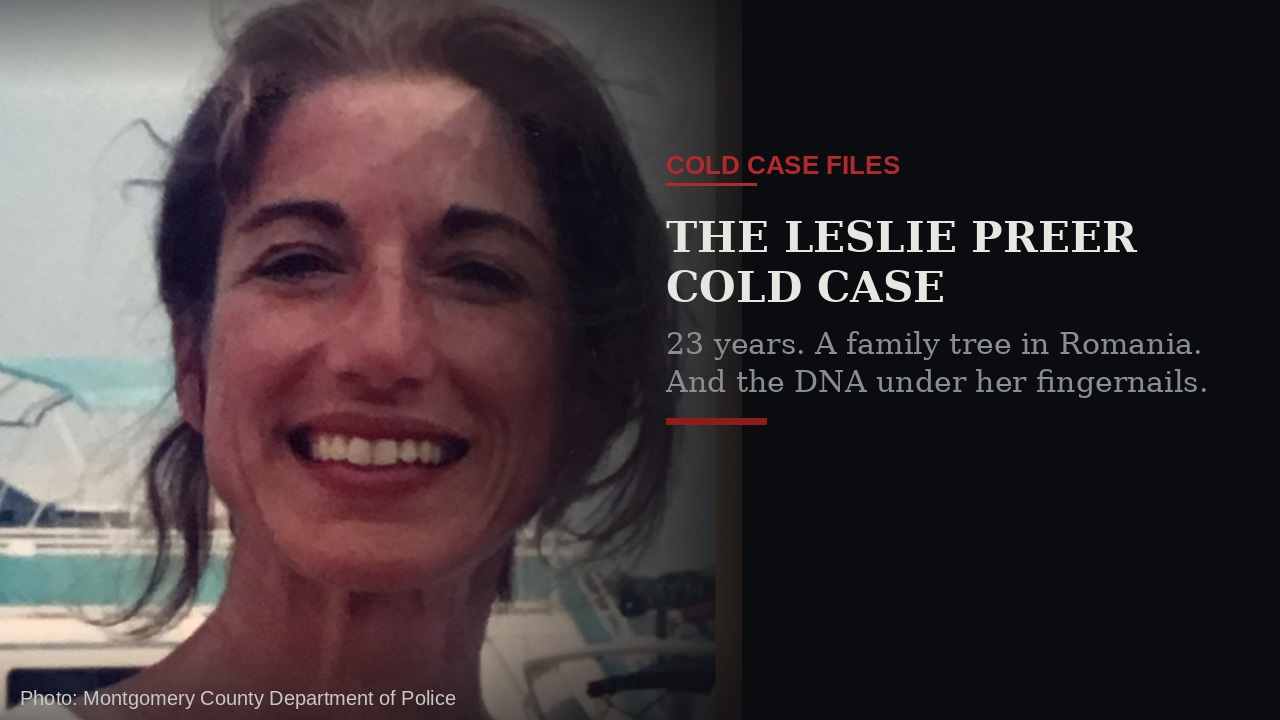
On May 2, 2001, 49-year-old Leslie Preer was beaten and strangled inside her home in Chevy Chase, Maryland. She fought her attacker, and the DNA she took from him under her fingernails was recovered within days. It matched no one in CODIS. It did not match her husband either — but for the next sixteen years, the neighborhood and much of the original investigation treated him as the answer anyway. He died in 2017, never publicly cleared.
What the officers found
Preer was found in her own home. The scene showed a struggle, and the physical evidence collected from it included genetic material that did not belong to her. In 2001 that meant one thing: a profile that could be compared against the Combined DNA Index System, the FBI-administered network of local, state and national DNA databases. CODIS does not search the population. It searches itself — convicted offenders, arrestees in some states, and other unsolved crime scenes. If the man who killed Leslie Preer had never been convicted of a qualifying offence, he was not there to be found.
Sixteen years pointed the wrong way
The DNA had excluded her husband within two months. That exclusion never changed the way the case was talked about locally, and he carried the suspicion until his death in 2017. It is worth stating plainly: the same evidence that eventually convicted the right man had already cleared the wrong one, years earlier.
2022: the file is reopened
Two Montgomery County cold case detectives took the file up again in 2022. The evidence had not changed — it had been preserved the entire time. What had changed was what could be read out of it. A genome-wide profile was built by Othram, and forensic genetic genealogists worked the resulting matches backward, building family trees outward from strangers for eighteen months. The line resolved to a family in Romania, and then to a surname — one that had been sitting in the original case file since a neighbour’s tip was logged in January 2002 and never acted on.
A water bottle at Dulles
Investigators collected a discarded DNA sample from Eugene Teodor Gligor at Dulles Airport on June 9, 2024. A warrant followed on June 15, and the arrest in June 2024. (Montgomery County Police give the arrest date as June 18; digital court records cited by Bethesda Today give June 21.)
The outcome
Gligor, 45, of Washington, D.C., pleaded guilty to second-degree murder on May 7, 2025. On August 28, 2025, Judge David Lease sentenced him in Montgomery County Circuit Court to 30 years with all but 22 years suspended, plus five years of supervised probation, a mental-health evaluation and a no-contact order.
Sources
- Montgomery County Department of Police — “Montgomery County Police Close 23-Year-Old Cold Case,” news release 24-268, June 18, 2024.
- Othram / DNASolves — “Montgomery County Police Department Teams with Othram to Identify the Suspect in 2001 Murder of Leslie Preer,” June 19, 2024.
- ABC News / 20/20 — Claire Lempert, September 12, 2025.
- Bethesda Today / Bethesda Magazine — August 28, 2025 (charging-document detail, sentencing).
- NBC4 Washington — May 7, 2025 (State’s Attorney John McCarthy remarks).
- WJLA / 7News — Brad Bell, August 28, 2025.
Full slide-by-slide image credits appear in the video itself.
Related reading
No book has been written about this case specifically. It is, however, a genuine forensic genetic genealogy case, and the book documenting how that technique was developed and first used is I’ll Be Gone in the Dark by Michelle McNamara (4.6★, 26,000+ ratings): https://www.amazon.com/dp/0062853171?tag=truecrimecases-20
As an Amazon Associate I earn from qualifying purchases.
Leave a Reply